



How Stablecoin Remittances Are Replacing Traditional Cross-Border Payment Rails for B2B Settlement
Stablecoin remittances are fundamentally reshaping how businesses settle cross-border payments, offering a faster and more cost-effective alternative to traditional banking infrastructure. SWIFT correspondent networks, while dominant for decades, introduce significant friction through multi-hop settlement chains, prolonged processing windows, and substantial intermediary fees. These inefficiencies create operational challenges for businesses managing global supplier payments, marketplace disbursements, and treasury operations.
This article explains how stablecoin-based settlement worksand outline the compliance and integration requirements businesses need to consider when adopting this technology. We will also compare stablecoins transaction cost and speed advantages against legacy systems as well as examine its real-world B2B applications.
Traditional B2B Cross-Border Payment Infrastructure and Its Limitations
Cross-border B2B payments move through correspondent banking networks built on decades-old infrastructure. A typical international wire routes through four distinct institutions before reaching the beneficiary [1]. The originating bank debits the sender and issues an MT103 customer credit transfer over SWIFT. When the originator’s bank lacks a direct account relationship with the beneficiary’s bank in the required currency, it routes the payment to a sending correspondent. This correspondent holds a nostro account in the destination currency and moves the value through its books to a receiving correspondent in the destination country. The receiving correspondent then credits the beneficiary bank’s vostro account, which finally credits the end customer [1]. This chain can extend to five or more hops on less common corridors, with each intermediary adding fees, potential FX conversion, and processing delays [1].
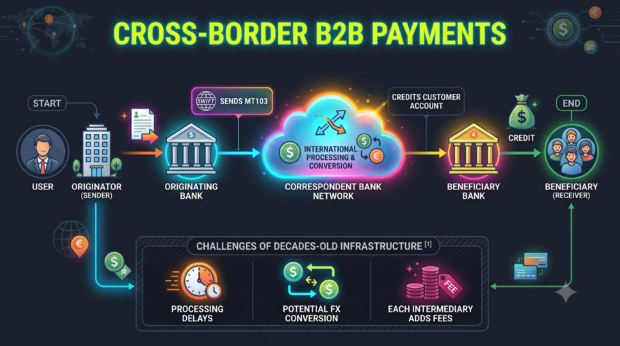
SWIFT Correspondent Banking Model: Multi-Hop Settlement Chains
SWIFT processes an average of 53 million messages daily across 11,500+ member institutions in more than 200 countries [2]. The network transmits standardized payment instructions between banks but does not move money itself [1]. Accordingly, sending a SWIFT message and settling a payment represent two separate processes. SWIFT GPI, launched in 2017, now carries 82% of all SWIFT cross-border payments across 4,200+ banks, with roughly 60% of GPI payments reaching beneficiaries within 30 minutes [2]. However, GPI functions as an overlay on existing correspondent infrastructure, providing tracking and speed commitments without changing the underlying settlement mechanism [2]. Messages move in seconds while money settles on each bank’s timeline through their correspondent relationships.
Settlement Windows and Domestic Processing Bottlenecks
RTGS systems that facilitate final settlement operate on restricted schedules with limited overlap across time zones [3]. A payment from the euro area to Indonesia can experience delays on the sender’s side from 17:00 to 06:00 GMT the next day, on the receiver’s side from 12:00 to 23:30 GMT, or during both closure periods from 17:00 to 23:30 GMT when both systems are closed [3]. Payments that miss operating windows wait for the next open session, adding full business days to settlement times. Traditional correspondent banking routes create 3-5 business day settlement windows [4], with some U.S. firms averaging a 33-day payment cycle [5]. By the time multiple institutions across different jurisdictions process a single payment, operational delays compound through sequential rather than concurrent processing.
Cost Structure: FX Markups and Intermediary Fees
The total cost of cross-border B2B payments comprises multiple layers that often remain invisible to senders. Large corporates typically pay 1-3% of transaction value, while SMEs face costs above 5% once all layers are factored in [2]. The World Bank tracks the global average cost of sending USD 200 at 6.49% as of Q1 2025 [2].
| Fee Layer | Typical Range | Applied By |
| Sending bank wire fee | USD 15-50 flat | Originating bank |
| Intermediary bank fees | USD 10-30 per hop | Each correspondent |
| Receiving bank fee | USD 10-25 flat | Beneficiary bank |
| FX markup | 0.5-4% above mid-market | Any bank performing conversion |
Banks and intermediaries quote conversion rates that differ from mid-market rates, creating markups typically between 1-4% for SMEs [2]. For a USD 100,000 invoice, a 2% FX markup costs USD 2,000, often exceeding all explicit wire fees combined [2]. Traditional banks may charge 1.5-3% above the interbank rate in hidden FX markups on top of per-transaction fees [6].
Nostro Account Liquidity Requirements Across Corridors
Correspondent banking requires banks to pre-fund nostro accounts in every currency corridor they serve. Industry estimates suggest USD 400 billion to over USD 1 trillion sits in these accounts globally [2], earning minimal return while waiting to facilitate future transactions. The average cost for a U.S. bank to execute a cross-border payment via correspondent banking ranges from USD 25 to USD 35, more than 10 times the cost of domestic payments [7]. Trapped liquidity in correspondent bank accounts represents 34% of this overall cost [7]. Each payment corridor requires its own capital allocation, with funds positioned in advance based on expected volumes [4]. This capital remains committed before transactions occur and stays tied to specific routes regardless of actual demand [4]. Treasury teams must monitor balances across multiple accounts and coordinate with various providers, each maintaining distinct settlement processes and timing requirements [4].
How Stablecoin Settlement Works for B2B Transactions
Stablecoin settlement operates through two primary models that serve different operational requirements. Wallet-to-wallet settlement involves direct blockchain transfers between self-custodial or custodial wallet addresses, where businesses maintain control over private keys or delegate custody to specialized providers. Account-to-account settlement, conversely, abstracts the blockchain layer entirely through payment service providers that manage wallets, compliance, and fiat conversion behind API endpoints [6][8]. Businesses interact with familiar account structures while providers handle on-chain mechanics, a model preferred by enterprises seeking traditional banking interfaces without direct crypto exposure.
Wallet-to-Wallet vs Account-to-Account Settlement Models
Direct wallet settlement requires businesses to manage blockchain addresses, monitor transaction confirmations, and coordinate key custody across treasury teams. Account-to-account models eliminate this operational burden by embedding stablecoin rails within existing payment workflows, where stablecoins exist only during the seconds required for settlement in an auto-sweep structure [9].
Four-Step Stablecoin Payment Flow: On-Ramp to Off-Ramp
The complete settlement cycle consists of four distinct stages. During the on-ramp phase, businesses convert fiat currency into stablecoins through bank transfers, ACH, or integrated payment APIs [6]. Identity verification through KYC and AML processes occurs before providers mint stablecoins or transfer them from reserve pools to the client’s designated wallet [8]. Transmission happens when stablecoins move directly from sender to recipient wallet addresses on the selected blockchain network, with settlement occurring in seconds to minutes depending on network characteristics [9]. Off-ramp conversion reverses the process as recipients send stablecoins to provider addresses, triggering fiat liquidation and deposit into traditional bank accounts [6][8]. Each leg routes through compliance controls including transaction monitoring and sanctions screening while preserving the speed advantages of blockchain settlement [8].
Network Selection: Ethereum, Solana, Stellar, and Base
Network choice determines transaction costs, settlement speed, and operational characteristics. Ethereum processes transactions with approximately 15-second block times, requiring 3-5 minutes for practical finality [4]. Solana delivers sub-second settlement with 400-millisecond block times and finality in roughly 12.8 seconds, processing USD 650 billion in stablecoin transactions during February 2026 alone [10]. Stellar offers 9.5-second settlement with near-zero transaction fees [11]. Base, an Ethereum Layer 2, provides settlement in approximately 2 seconds with fees between USD 0.00 and USD 0.01 [10][4].
USDC, USDT, PYUSD: Choosing the Right Stablecoin for B2B Flows
USDC maintains the strongest regulatory position with NYDFS approval and weekly attestations confirming 100% backing by cash and short-term U.S. Treasuries [4]. Circle issues USDC natively across Ethereum, Solana, Base, Arbitrum, Polygon, and Avalanche, with Cross-Chain Transfer Protocol enabling native movement between networks without bridge risk [4]. USDT dominates global liquidity with the largest market cap, processing roughly half of all transfers on Tron where fees remain minimal [4]. PYUSD, issued by Paxos under PayPal branding, operates exclusively on Ethereum and Solana with tight integration into PayPal’s existing payment infrastructure [4][4].
Cost and Speed Advantages: Traditional Rails vs Stablecoin Settlement
Operational efficiency separates stablecoin remittances from correspondent banking infrastructure through measurable improvements across settlement speed, transaction costs, and capital deployment. Cross-border wires route through multiple correspondent banks, with funds arriving two to five days later and only during banking hours [5]. Token transfers, conversely, settle in minutes regardless of time zone or public holidays [5]. SWIFT tracking data shows that 90% of payments reach beneficiary banks within an hour, yet only 43% reach the end customer within that same timeframe due to domestic processing delays [12].
Settlement Speed: Days to Minutes Across Time Zones
A study of 5,621 real SWIFT transactions found an average processing time of 27 hours, with 64% arriving within 24 hours [13]. Transfers involving currency conversion averaged 4.6 days due to correspondent banking delays [13]. Stablecoin settlement finalizes in seconds to a few minutes [12], with USDC on Base or Solana settling in roughly 2 to 10 seconds for under USD 0.01 [14]. Practical end-to-end time, including on-ramp and off-ramp conversion, ranges from 1 minute to 2 hours depending on corridor and processor liquidity [14].
Transaction Cost Comparison: Network Fees vs Correspondent Charges
Traditional providers layer fees and wide FX spreads, whereas blockchain fees are measured in cents [5]. Every cross-border payout costs 2.5-6% before it clears, with wires carrying USD 25-50 fees plus correspondent bank cuts [15]. Network fees on a USDC transfer typically cost a few cents [12]. Firms using stablecoins for cross-border B2B payments report up to 60% cost savings versus the global remittance average of 6.35% in Q1 2024 [15]. For a USD 10,000 transfer from the US to Mexico, SWIFT costs total USD 115-200 all-in, while stablecoin settlement via payment processors costs USD 35-80, generating net savings of USD 80-120 plus 1-3 day acceleration [14]. The savings widen as transfer size grows because SWIFT FX spread is percentage-based while stablecoin FX is closer to flat [14].
24/7 Availability Without Banking Hours Constraints
Blockchain settlement operates continuously, not subject to banking hours, holidays, or weekends [12]. Visa’s onchain analytics reveal that weekend transaction volumes average billions of dollars per day, underscoring growing reliance on stablecoins for round-the-clock financial activities [16]. Treasury teams can move value across weekends and holidays without waiting for the next market window [12].
Improved Transparency with Onchain Transaction Records
Every onchain transaction is visible in real time, while legacy rails leave treasury teams chasing reference numbers through intermediaries [5]. Every stablecoin transaction is recorded on a public ledger with a verifiable hash, allowing sender and recipient to both confirm the transfer in real time [12].
Liquidity Management: Eliminating Prefunded Corridor Accounts
An estimated USD 4 trillion sits idle in prefunded accounts across the global payments industry [6]. Stablecoin settlement reduces the need to trap liquidity across multiple prefunded accounts [12], allowing businesses to hold liquidity centrally and deploy it to any corridor in minutes [12].
Real-World B2B Use Cases and Adoption Patterns
B2B stablecoin payments grew 733% last year to USD 226 billion in volume, the largest single use-case category ahead of remittances and retail transactions [8]. Three dominant patterns drive this adoption: vendor settlements, treasury operations, and cross-border workforce payments [8].
Supplier Invoice Settlements and Procurement Payments
A U.S. importer paying a Vietnamese factory USD 200,000 monthly for finished goods historically wired through correspondent banks at USD 35 per wire with 3-5 day settlement [17]. Stablecoin settlement completes in under 1 minute for under USD 50 all-in including off-ramp to VND [17]. Importers and ecommerce wholesalers use processors including BVNK and Bridge for supplier payouts in Mexico, Vietnam, the Philippines, India, and African corridors [17]. The 2024 KNOMAD remittance brief documented stablecoin-rail savings of 80-95% versus SWIFT on USD 10,000 to USD 250,000 transfers in corridors with deepest stablecoin liquidity [17].
Marketplace Payouts to Global Sellers
Deel enables 10,000+ contractors across 100+ countries to receive wages in stablecoins, processing over 125,000 successful stablecoin payouts through BVNK infrastructure [11]. Worldpay offers stablecoin payouts to merchants paying sellers, creators, and hosts in emerging markets [11]. BVNK reports 5x monthly volume growth in stablecoin payments over the last 12 months [11]. A Stripe survey of 2,300 independent workers in 20 countries found 57% would accept stablecoin payouts if platforms provided them [18].
Treasury Operations and Intercompany Transfers
Circle Treasury moved more than USD 68 million in USDC-settled transactions across 11 flows spanning 8 entities in under 30 minutes, compared with one-to-two-day settlement typical in fiat environments [10]. The team completed approximately 90% of intercompany settlements related to transfer pricing activity in a single day, processing more than 26 manual transfer pricing movements [10].
Contractor and Workforce Cross-Border Payroll
Bitwage reports paying over 90,000 workers across 4,500 companies since 2014 [19]. Rise Pay processes payroll for 700+ companies across 190 countries as of 2025 [19]. Argentina alone holds an estimated USD 3 billion in stablecoin balance, much tied to contractor payments [17].
Implementation Requirements and Risk Considerations
Deploying stablecoin remittances requires navigating compliance obligations, regulatory frameworks, and operational risks that differ substantially from traditional payment infrastructure.
Compliance Framework: KYB, AML, and Travel Rule Requirements
Payment platforms must implement Know Your Business verification, collect beneficial ownership information for business customers, and conduct ongoing transaction monitoring [20]. The Travel Rule requires sharing originator and beneficiary identity data for transfers exceeding USD 3000 [20]. Stablecoin issuers classified as Permitted Payment Stablecoin Issuers must file suspicious activity reports for transactions involving USD 5000 or more and maintain enhanced due diligence programs [20]. Compliance tools from Chainalysis and Elliptic provide real-time blockchain analytics and sanctions screening against OFAC lists [21].
Regulatory Landscape: GENIUS Act and MiCA Authorization
The GENIUS Act, enacted July 2025, requires stablecoins to be fully backed by USD cash, short-duration Treasury instruments (93 days or less), and subject to monthly attestations by PCAOB-registered accounting firms [4][22]. Issuers exceeding USD 10 billion in circulation must operate under federal oversight [23][22]. MiCA, effective December 2024 in Europe, imposes licensing requirements for stablecoin issuers with full reserves held in highly liquid, low-risk instruments [22].
Choosing Payment Networks: Mesh, Bridge, BVNK, and Circle
Bridge, BVNK, and Circle provide compliant infrastructure with embedded KYC/KYB flows requiring 3 to 5 business day approval [24]. Circle Mint operates with business-level verification, while BVNK handles compliance reviews and activates customer accounts once approved [25].
Integration Options: API, Portal, or Embedded Workflows
API providers build regulatory controls into platforms, offering identity verification and transaction monitoring tools [26]. The embedded model allows platforms to offer stablecoin capabilities to customers through API submission of customer information with webhook-based status tracking [25]. Production activation requires coordination with account managers and replication of sandbox configurations [25].
Managing Counterparty and Depeg Risk Across Issuers
Moody’s calculated over 600 depegs by large cap stablecoins in 2022 and 2023 [4]. USDC traded as low as USD 0.87 during Silicon Valley Bank’s collapse in March 2023 [27]. USDe temporarily traded at USD 0.65 on October 10, 2025, during market selloffs [27]. Stablecoin holders remain exposed to issuer bankruptcy risk despite regulatory safeguards [4]. Treasury teams should treat stablecoin issuer risk identically to any financial counterparty, understanding regulatory status, capital structure, and operational controls [9].
Conclusion
Stablecoin remittances deliver measurable advantages over correspondent banking infrastructure across every operational dimension that matters for B2B settlement. Settlement times compress from days to minutes, transaction costs drop 60-95%, and treasury teams eliminate billions in trapped corridor liquidity. Above all, the technology operates continuously without banking hour constraints while providing real-time transaction visibility.
The 733% growth in B2B stablecoin volume reflects enterprise recognition of these benefits across supplier payments, marketplace disbursements, treasury operations, and global payroll. As regulatory frameworks mature through MiCA and the GENIUS Act, businesses gain clearer compliance pathways to integrate this infrastructure. Thus, stablecoin rails are not replacing traditional payments eventually but displacing them now.
References
[1] – https://eco.com/support/en/articles/16665742-correspondent-banking-explained-why-cross-border-payments-still-take-days
[2] – https://www.spark.money/research/cross-border-b2b-payments-broken
[3] – https://www.bis.org/publications/extending-and-aligning-payment-system-operating-hours-cross-border-payments.pdf
[4] – https://www.statestreet.com/us/en/insights/stablecoin-moment
[5] – https://www.rapyd.net/blog/what-is-a-stablecoin/
[6] – https://www.nium.com/blog/stablecoins-fix-global-payroll-liquidity
[7] – https://www.mas.gov.sg/-/media/MAS/ProjectUbin/Cross-Border-Interbank-Payments-and-Settlements.pdf
[8] – https://ramp.com/blog/b2b-stablecoin-payments
[9] – https://www.kyriba.com/resources/insights/stablecoin-guide-treasury
[10] – https://www.circle.com/case-studies/circle-treasury-management
[11] – https://www.linkedin.com/pulse/send-stablecoins-fast-lane-global-payouts-jesse-hemson-struthers-pab3f
[12] – https://www.crossriver.com/insights/stablecoin-cross-border-payments-how-businesses-can-speed-international-cash-flow
[13] – https://www.spark.money/tools/cross-border-payment-speed-comparison
[14] – https://eco.com/support/en/articles/14797802-cross-border-stablecoin-payments-vs-swift
[15] – https://www.paystand.com/blog/blockchain-payments
[16] – https://visaonchainanalytics.com/transactions
[17] – https://eco.com/support/en/articles/14797800-b2b-stablecoin-payments-business-use-cases
[18] – https://stripe.com/blog/why-global-workers-are-driving-demand-for-stablecoin-payouts
[19] – https://eco.com/support/en/articles/14799234-stablecoin-payroll-how-to-pay-workers-in-usdc-and-usdt
[20] – https://businesslawtoday.org/2026/06/from-money-transmitters-to-ppsis-treasurys-proposed-stablecoin-compliance-framework/
[21] – https://www.chainalysis.com/stablecoin-risk-management/
[22] – https://www.paxos.com/blog/how-are-stablecoins-regulated
[23] – https://www.weforum.org/stories/financial-and-monetary-systems/us-genius-act-eu-mica-convergence-crypto-rules/
[24] – https://www.apideck.com/blog/stablecoin-apis-new-payments-infrastructure-layer
[25] – https://docs.bvnk.com/bvnk/use-cases/stablecoin-payments-for-platforms/prepare-for-integration/
[26] – https://stripe.com/resources/more/stablecoin-api-infrastructure-for-flexible-compliant-money-movement
[27] – https://bpi.com/stablecoin-risks-some-warning-bells/

About the author


From Marvel to Reality: Can ChatGPT Astra Finally Match Iron Man’s J.A.R.V.I.S.?
When Tony Stark stood in his Malibu workshop in the 2008 movie Iron Man, speaking casually to the ceiling while holographic schematics spun in midair, millions of viewers thought the same thing: science fiction is cool, but we’re a century away from that. Stark’s digital butler, J.A.R.V.I.S. (Just A Rather Very Intelligent System), didn't wait around for someone to click a search button or type a prompt. He listened, watched, reasoned through complex engineering problems, manipulated software on the fly, and acted as an effortless extension of Stark’s mind. Today, frontier AI models like ChatGPT (GPT-6 Astra)—alongside Google's real-time vision initiative Project Astra—have pulled humanity startlingly close to that fictional universe. What makes an AI system like Astra so radically different from the text chatbots of yesterday, what can it actually do in practical terms, and how close does it […]

How Stablecoin Remittances Are Replacing Traditional Cross-Border Payment
How Stablecoin Remittances Are Replacing Traditional Cross-Border Payment Rails for B2B Settlement Stablecoin remittances are fundamentally reshaping how businesses settle cross-border payments, offering a faster and more cost-effective alternative to traditional banking infrastructure. SWIFT correspondent networks, while dominant for decades, introduce significant friction through multi-hop settlement chains, prolonged processing windows, and substantial intermediary fees. These inefficiencies create operational challenges for businesses managing global supplier payments, marketplace disbursements, and treasury operations. This article explains how stablecoin-based settlement worksand outline the compliance and integration requirements businesses need to consider when adopting this technology. We will also compare stablecoins transaction cost and speed advantages against legacy systems as well as examine its real-world B2B applications. Traditional B2B Cross-Border Payment Infrastructure and Its Limitations Cross-border B2B payments move through correspondent banking networks built on decades-old infrastructure. A typical international wire routes through four distinct […]
The Best Travel Apps: Streamlining Your Journey
In a landmark development, the tech industry has unveiled an innovative solution that promises to revolutionize the way businesses operate. The breakthrough, dubbed "SyncPro", is a cutting-edge software platform designed to streamline communication and enhance productivity in the workplace. The innovation is here "We believe SyncPro will redefine the future of work" says John Doe, CEO of Tech Innovations Inc. "By leveraging advanced technologies, we're empowering businesses to adapt and thrive in an increasingly competitive landscape." SyncPro harnesses the power of artificial intelligence and machine learning to optimize workflows and automate routine tasks. Its intuitive interface integrates seamlessly with existing systems, allowing for effortless data synchronization across departments and devices. This enables real-time collaboration and decision-making, fostering a more agile and responsive business environment. The Code behind the innovation // This is an example code /* =================================== */ Additional functionalities […]
Overcoming Common Obstacles in Small Business Management
In a landmark development, the tech industry has unveiled an innovative solution that promises to revolutionize the way businesses operate. The breakthrough, dubbed "SyncPro", is a cutting-edge software platform designed to streamline communication and enhance productivity in the workplace. The innovation is here "We believe SyncPro will redefine the future of work" says John Doe, CEO of Tech Innovations Inc. "By leveraging advanced technologies, we're empowering businesses to adapt and thrive in an increasingly competitive landscape." SyncPro harnesses the power of artificial intelligence and machine learning to optimize workflows and automate routine tasks. Its intuitive interface integrates seamlessly with existing systems, allowing for effortless data synchronization across departments and devices. This enables real-time collaboration and decision-making, fostering a more agile and responsive business environment. The Code behind the innovation // This is an example code /* =================================== */ Additional functionalities […]
The Role of AI in Revolutionizing Customer Service
In a landmark development, the tech industry has unveiled an innovative solution that promises to revolutionize the way businesses operate. The breakthrough, dubbed "SyncPro", is a cutting-edge software platform designed to streamline communication and enhance productivity in the workplace. The innovation is here "We believe SyncPro will redefine the future of work" says John Doe, CEO of Tech Innovations Inc. "By leveraging advanced technologies, we're empowering businesses to adapt and thrive in an increasingly competitive landscape." SyncPro harnesses the power of artificial intelligence and machine learning to optimize workflows and automate routine tasks. Its intuitive interface integrates seamlessly with existing systems, allowing for effortless data synchronization across departments and devices. This enables real-time collaboration and decision-making, fostering a more agile and responsive business environment. The Code behind the innovation // This is an example code /* =================================== */ Additional functionalities […]
The Intersection of Art and Technology in Entertainment
In a landmark development, the tech industry has unveiled an innovative solution that promises to revolutionize the way businesses operate. The breakthrough, dubbed "SyncPro", is a cutting-edge software platform designed to streamline communication and enhance productivity in the workplace. The innovation is here "We believe SyncPro will redefine the future of work" says John Doe, CEO of Tech Innovations Inc. "By leveraging advanced technologies, we're empowering businesses to adapt and thrive in an increasingly competitive landscape." SyncPro harnesses the power of artificial intelligence and machine learning to optimize workflows and automate routine tasks. Its intuitive interface integrates seamlessly with existing systems, allowing for effortless data synchronization across departments and devices. This enables real-time collaboration and decision-making, fostering a more agile and responsive business environment. The Code behind the innovation // This is an example code /* =================================== */ Additional functionalities […]
Be the first to leave a comment